

AI referrals & questions answered
AI referrals & questions answered
Section titled “AI referrals & questions answered”The Referrals tab of the AI Traffic view is an attention funnel with three stages. It sits beside the crawler tabs because it is the other half of the same story: a crawler fetches the page, an assistant cites it, a human arrives. With Flowcourier Analytics installed the view is a tab in the Analytics section; on a site running AEO alone it is under Settings → Flowcourier → AEO Dashboard.
- AI reads — a user-triggered assistant fetcher (ChatGPT-User, Claude-User, Perplexity-User, Gemini’s fetchers, …) read a page to answer someone’s question. This is the earliest observable signal that your content is reaching AI answers, and since 17.5.8 it leads the page: a “Recent AI reads” timeline shows when, which assistant, which page (by title) and in what format (HTML, Markdown, llms.txt).
- AI referrals — a human arrived from an AI surface: the Referer host
(or
utm_source) matches claude.ai, chatgpt.com, perplexity.ai, copilot.microsoft.com, gemini.google.com or your ownReferralHostsadditions. - Questions answered — the two correlated: the conversion metric.
Reads without referrals are normal — most people read the AI’s answer and never click a citation. The page says so explicitly instead of showing an empty state. To understand what the AI was asked, see What AI assistants asked.
Questions answered
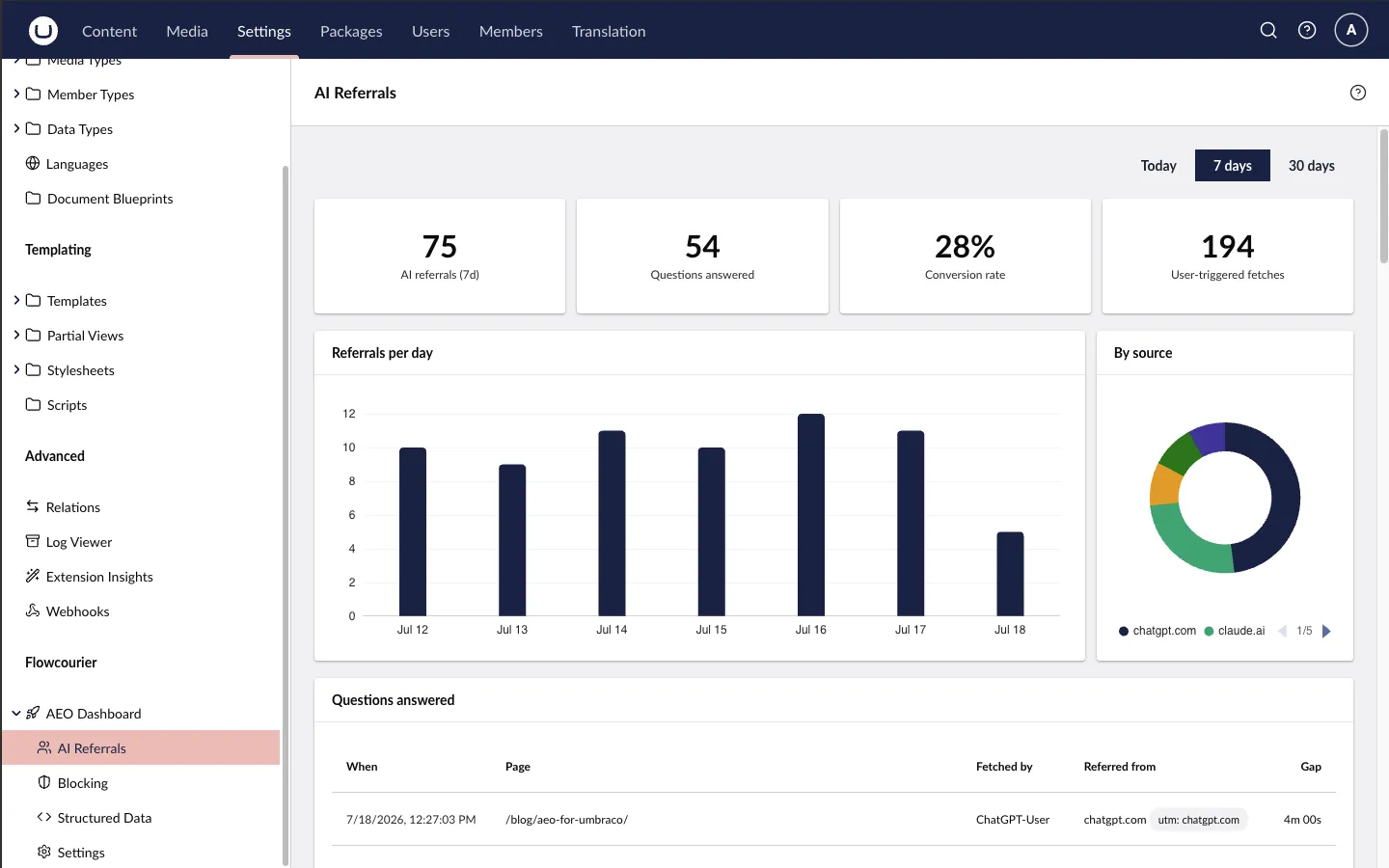
Section titled “Questions answered”The headline metric is “questions answered”: a user-triggered crawler fetch (an Assistant-type crawler like ChatGPT-User or Claude-User reading your page to answer someone’s prompt — the “User-triggered” intent on the crawler dashboard) followed within 30 minutes by an AI-referred human visit to the same path. That pairing is the closest observable proxy for “someone asked an AI, it cited your page, and they clicked through”.
The page shows:
- Stat cards — AI reads, AI referrals, questions answered, and the conversion rate (questions answered ÷ AI reads) for the window.
- Recent AI reads — the timeline of assistant fetches, with the page’s title standing in for the question it was answering.
- Referrals per day — the trend over the selected Today / 7-day / 30-day window.
- By source — which AI surface sent the visitors (ChatGPT, Claude, Perplexity, …).
- Questions answered — the conversion list: the page, the fetching bot, the referring surface, and the time gap between the fetch and the visit.
Privacy
Section titled “Privacy”Referral hits are recorded with no IP address, no user agent and no query
string — the path is stored without its query, utm_source is parsed and the
rest discarded — which keeps the FcAeoReferralHit table outside personal-data
scope by construction. Rows are kept forever by default
(ReferralRetentionDays: 0) — deliberately: the table holds no personal data,
and long history is what makes the “questions answered” trend useful. Set a
positive number of days to prune older ones; pruning runs in short batches,
like crawler hits.
appsettings reference
Section titled “appsettings reference”All settings are optional, under Flowcourier:Aeo:CrawlerAnalytics:
| Setting | Default | Description |
|---|---|---|
ReferralHosts |
claude.ai, chatgpt.com, perplexity.ai, copilot.microsoft.com, gemini.google.com |
AI surfaces whose outbound clicks count as referrals (matched on Referer host, including subdomains, or utm_source). Configured entries are added to these built-in defaults, not replaced. |
ReferralRetentionDays |
0 |
Days of referral hits to keep; 0 keeps them forever (deliberate: no personal data is stored, and long history is what makes the trend useful). |
The correlation only needs crawler analytics to be on — referrals pair each AI-referred visit with the earlier User-triggered (Assistant-type) fetch of the same page, the intent described in AI crawler analytics.