

Structured data (JSON-LD)
Structured data (JSON-LD)
Section titled “Structured data (JSON-LD)”Every eligible rendered page gets one <script type="application/ld+json"> in its <head> with a schema.org graph. Page-level markup is generated from your content — no templates to edit; the organization identity is the one thing you fill in yourself (a two-minute form in the backoffice).
What gets emitted
Section titled “What gets emitted”Organization— your company identity, and the one node that is never guessed: it only emits once a name has been provided. Emitted on the homepage by default (schema.org guidance: one representative page is enough); setSchema.OrganizationOnAllPagesif you want it everywhere.WebSite— homepage only: site name + URL.WebPage/Article/NewsArticle/ … — every page, typed viaSchema.TypeMappings(doc-type alias → schema.org type; blog/news doc-types map to articles out of the box). Includes title, description, URL, language,datePublished(from your date property, falling back to the create date),dateModifiedand the author (string fields and content pickers both resolve).BreadcrumbList— the page’s ancestor trail, on every page below the homepage.FAQPage— when the page (or any of its Block List / Block Grid elements) has a filled question and answer property (question/answerby default — configurable), the pairs are emitted as FAQ markup. Rich-text answers are stripped to plain text.
Eligibility follows the same rules as the Markdown surface: preview renders, non-200 responses, no-indexed pages and excluded document types never emit schema. The graph is cached per page + culture (Schema.CacheSeconds, default 300) and refreshed on publish.
Validate your output at validator.schema.org or Google’s Rich Results test.
The Structured Data form
Section titled “The Structured Data form”Editors fill in the organization identity under Settings → Flowcourier → AEO Dashboard → Structured Data (the group is named AEO on a site that also runs Flowcourier Analytics): name, legal name, URL, logo, profile links (sameAs), email and phone. The values are stored in the database.
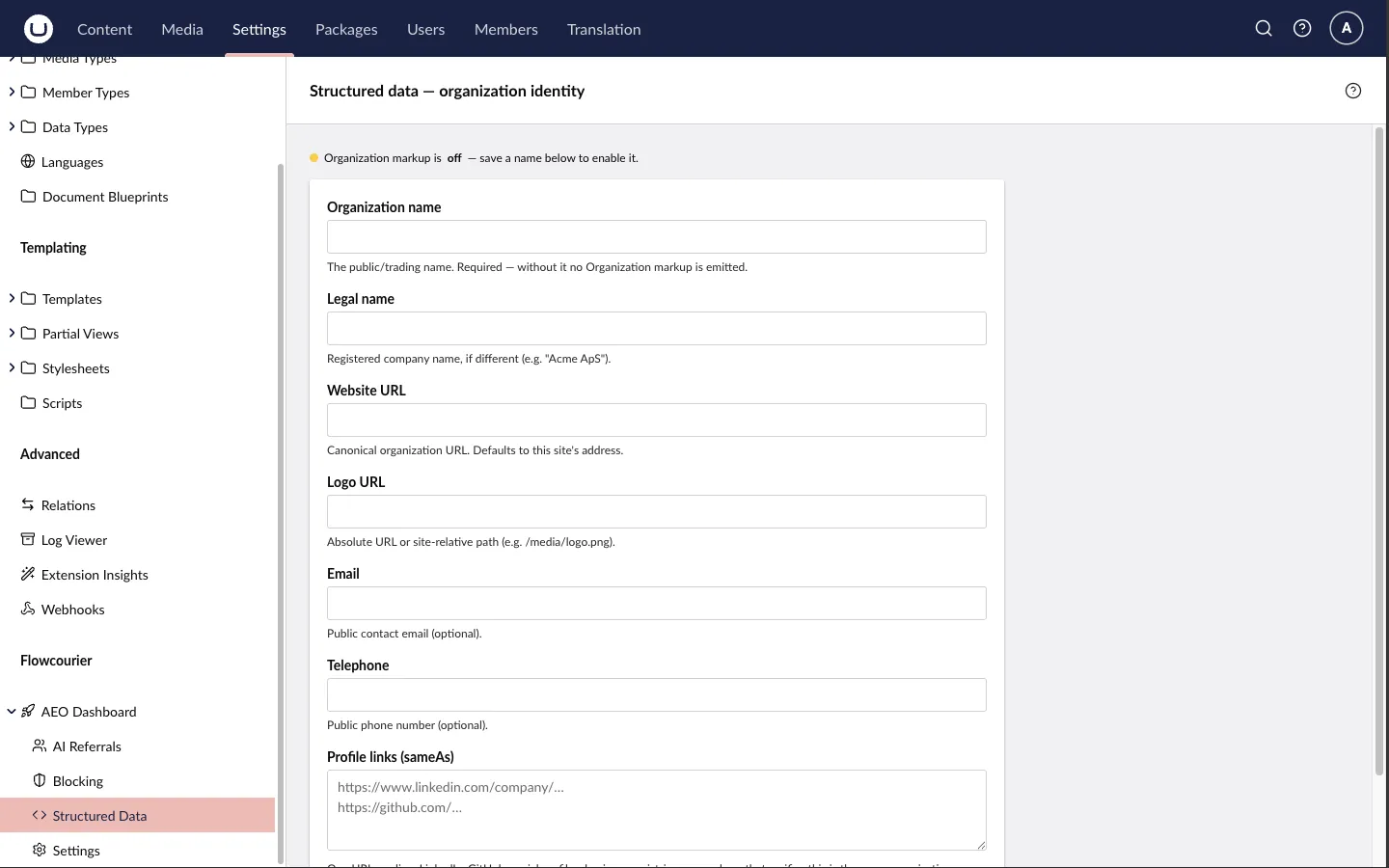
Fill in SameAs (your LinkedIn/GitHub/social profiles), LogoUrl and LegalName for real deployments — verified identity is a core AI trust signal.
Developers can set the same fields via Schema:Organization in appsettings; backoffice values win field by field. No name in either place = no Organization markup.
appsettings reference
Section titled “appsettings reference”All settings live under Flowcourier:Aeo:Schema and are optional:
{ "Flowcourier": { "Aeo": { "Schema": { "Enabled": true, "EnableOrganization": true, "OrganizationOnAllPages": false, "EnableWebSite": true, "EnableWebPage": true, "EnableBreadcrumbs": true, "EnableFaq": true, "CacheSeconds": 300, "Organization": { "Name": null, "LegalName": null, "Url": null, "LogoUrl": null, "SameAs": [], "Email": null, "Telephone": null }, "TypeMappings": { "blogpost": "Article", "newsItem": "NewsArticle" }, "DatePublishedPropertyAliases": [ "publishDate", "articleDate", "postDate", "date" ], "AuthorPropertyAliases": [ "author", "authorName", "writer" ], "Faq": { "DocumentTypes": [], "QuestionPropertyAliases": [ "question", "faqQuestion" ], "AnswerPropertyAliases": [ "answer", "faqAnswer" ] } } } }}| Setting | Default | Description |
|---|---|---|
Enabled |
true |
Inject a JSON-LD graph into the <head> of rendered pages. |
EnableOrganization |
true |
Allow the Organization node (homepage only unless OrganizationOnAllPages). It only actually emits once a name is provided — on the Structured Data form or in Organization. |
OrganizationOnAllPages |
false |
Repeat the Organization node on every page instead of just the homepage. |
EnableWebSite |
true |
Emit a WebSite node on the homepage. |
EnableWebPage |
true |
Emit a WebPage (or mapped Article/…) node on every eligible page. |
EnableBreadcrumbs |
true |
Emit a BreadcrumbList on pages below the homepage. |
EnableFaq |
true |
Emit an FAQPage node when question/answer pairs are found. |
CacheSeconds |
300 |
Cache lifetime for the serialized graph per (page, culture); publishes clear it immediately. |
Organization.* |
unset | Organization identity in appsettings (name, legal name, URL, logo, sameAs profiles, email, phone). The backoffice form overrides these field by field. |
TypeMappings |
blog/news → Article | Doc-type alias → schema.org type for the per-page node; unmapped types emit WebPage. |
DatePublishedPropertyAliases |
publishDate, … |
Aliases checked in order for datePublished; falls back to the node’s create date. |
AuthorPropertyAliases |
author, … |
Aliases checked in order for the author (string values and content pickers both resolve). |
Faq.DocumentTypes |
[] |
Doc-type filter for FAQ markup; empty = all pages are scanned. |
Faq.QuestionPropertyAliases / Faq.AnswerPropertyAliases |
question / answer + faq* |
The question/answer aliases scanned on the page and its Block List/Grid elements. |