

Crawler verification & blocking
Crawler verification & blocking
Section titled “Crawler verification & blocking”A surprising share of “AI crawler” traffic is fake. Vulnerability scanners wear
ClaudeBot, GPTBot or Amazonbot user agents to slip past naive bot filters while
probing for /.env, private keys, admin panels and debug endpoints. Real AI
crawlers don’t do that — and most vendors publish an official way to prove an
address is really theirs. Flowcourier AEO uses it.
Every request whose user agent claims a known AI crawler is verified against
the vendor’s official mechanism, spoofers are blocked with 403 (on by
default), and repeat offenders escalate onto a persistent block list you manage
in the backoffice.
How verification works
Section titled “How verification works”Each vendor’s own published mechanism is checked:
| Vendor | Crawlers | Mechanism |
|---|---|---|
| OpenAI | GPTBot, ChatGPT-User, OAI-SearchBot | Published IP-range lists |
| Anthropic | ClaudeBot, Claude-User, Claude-SearchBot | Published IP-range list |
| Perplexity | PerplexityBot, Perplexity-User | Published IP-range lists |
| GoogleOther, Google-Extended | Published IP-range list + reverse DNS | |
| Apple | Applebot-Extended | Published IP-range list + reverse DNS |
| Amazon | Amazonbot | Reverse DNS (PTR + forward-confirm) |
| DuckDuckGo | DuckAssistBot | Published IP-range list |
| Common Crawl, ByteDance, Meta, Cohere, Mistral, You.com, AI2, Diffbot | CCBot, Bytespider, Meta-*, … | None published — permanently unverifiable |
Every recognised-crawler request gets one of three verdicts, shown as a badge in the dashboard’s recent-visits log:
- Verified — the source address matches the vendor’s published ranges or reverse DNS. This really is the crawler it claims to be.
- Spoofed — the vendor’s sources were available and the address
definitively failed them. The request is provably fake and is blocked
(unless you turn
BlockSpoofedoff, in which case it’s recorded but served). - Unverifiable — no mechanism exists for that crawler, sources are still loading, or DNS failed. Never blocked on verification grounds.
Verification is built fail-open and adds no request latency:
- IP-list fetches and DNS lookups run out of band — the first request from an unknown address passes through while verification resolves; subsequent requests hit a cached verdict.
- List-fetch failures, DNS timeouts and missing source addresses all read as unverifiable, never as spoofed. Stale vendor lists keep serving while a refresh runs. Only a definitive mismatch ever blocks.
- Verdicts are compared in memory only — verification stores no IP addresses (see Privacy).
Spoofed hits are also excluded from the analytics aggregates — scan probes no longer pollute your Top pages, per-crawler counts or traffic charts. They surface instead as a “Spoofed requests blocked” stat card and a distinct “Spoofed” slice in the traffic-share donut, so the activity stays visible without masquerading as real crawler traffic.
Three strikes → the durable block list
Section titled “Three strikes → the durable block list”While a scanner is actively hammering your site, the in-memory verdict cache
blocks every request — that whole burst counts as one offense episode. An
address that comes back later and spoofs again earns another strike. After
StrikesBeforeDurableBlock episodes (default 3), the address is written to
the durable block list (FcAeoBlockedClient), which survives restarts and
expires on a rolling window (DurableBlockRetentionDays, default 90 days after
the last offense — persistent attackers never age out).
Two safety properties are built in:
- Durable blocks only apply to requests presenting an AI-crawler user agent. A shared office IP, carrier NAT or VPN egress that once hosted a scanner can never lock out normal visitors browsing your site.
- An address that rotates several fake crawler identities (ClaudeBot, then GPTBot, then Amazonbot) burns a strike per identity and escalates faster — stronger evidence, faster block.
The Blocking page
Section titled “The Blocking page”Open Settings → Flowcourier → AEO Dashboard → Blocking (the group is named AEO on a site that also runs Flowcourier Analytics):
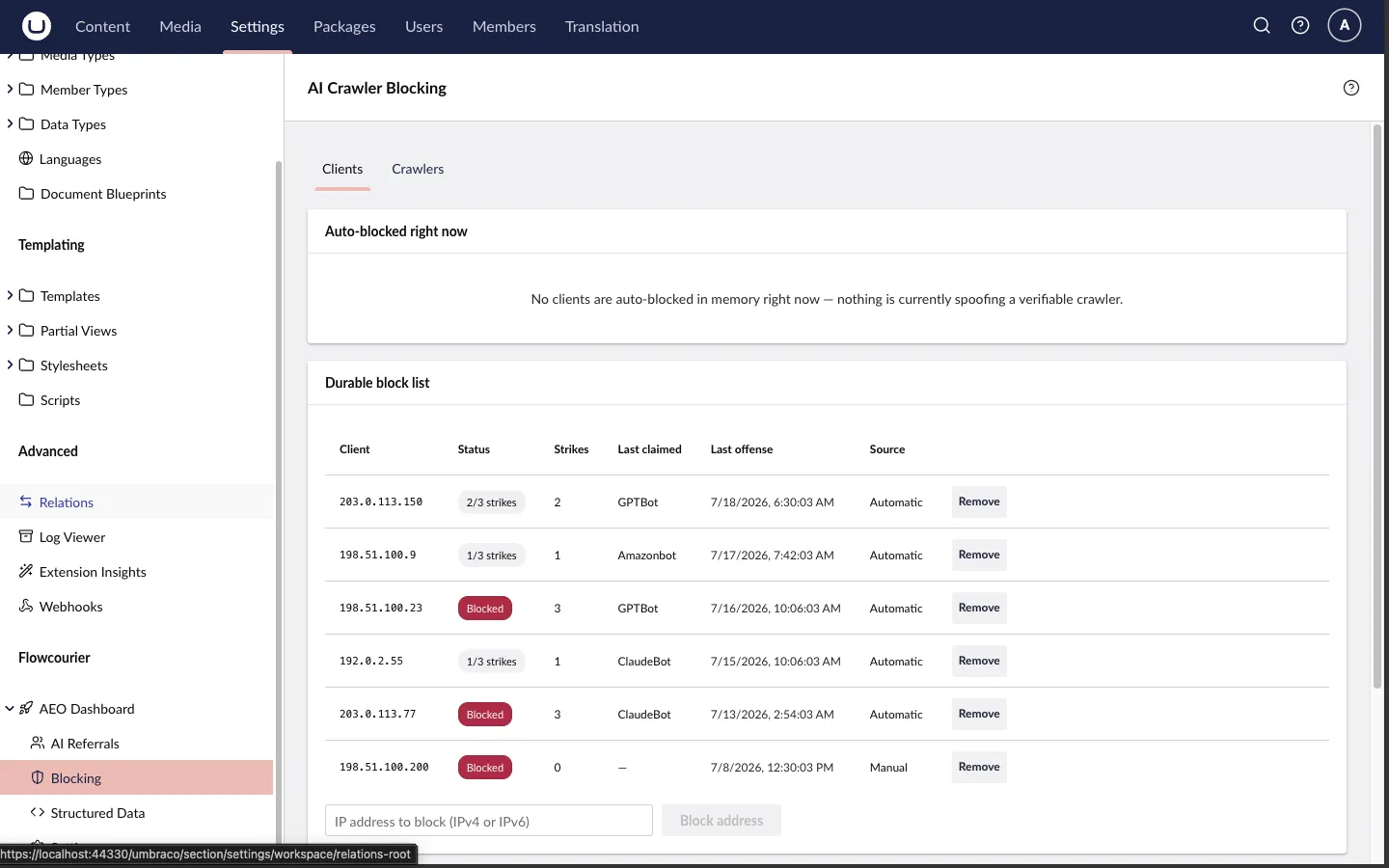
The page has two tabs.
Clients tab
Section titled “Clients tab”- Auto-blocked right now — a live, in-memory view: clients that claimed to
be a verifiable crawler (GPTBot, ClaudeBot, …) from an address that provably
isn’t the vendor’s, so their requests are answered
403right now. Nothing is stored yet — each entry lapses on its own when the cached verdict expires (about an hour). Coming back and spoofing again counts as a strike; after the configured number of strikes (default 3) the address moves to the durable block list. One click promotes any entry there immediately. - Block list — the durable record, stored in the database: addresses that
kept spoofing (hit the strike threshold) or that you blocked manually. They
stay blocked across restarts until
DurableBlockRetentionDaysafter their last offense, and only for requests wearing an AI-crawler user agent. Rows shown as “x/3 strikes” are offense records still counting toward a block, not blocks yet. Each row has a Remove button, and you can block any IP address manually. - Why is an address on the list? Every strike records its evidence — when it happened, which crawler the request claimed to be, and which verification mechanism proved the claim false (published IP ranges or reverse DNS). The Why? button on a block-list row opens that history in plain language, e.g. “claimed GPTBot, but the address is outside the vendor’s published IP ranges.” The history keeps the last 10 offenses per address; rows recorded before AEO 17.5.7 (and manual blocks) have no history.
- Allowlist — addresses (or CIDR ranges, e.g.
203.0.113.0/24) AEO never answers with403: crawler policy blocks, spoof blocking and the durable block list are all bypassed for them. Use it for your own uptime monitoring, a staging network, or a partner’s fetcher. Their visits are still recorded and verified in analytics — the allowlist only suppresses blocking.
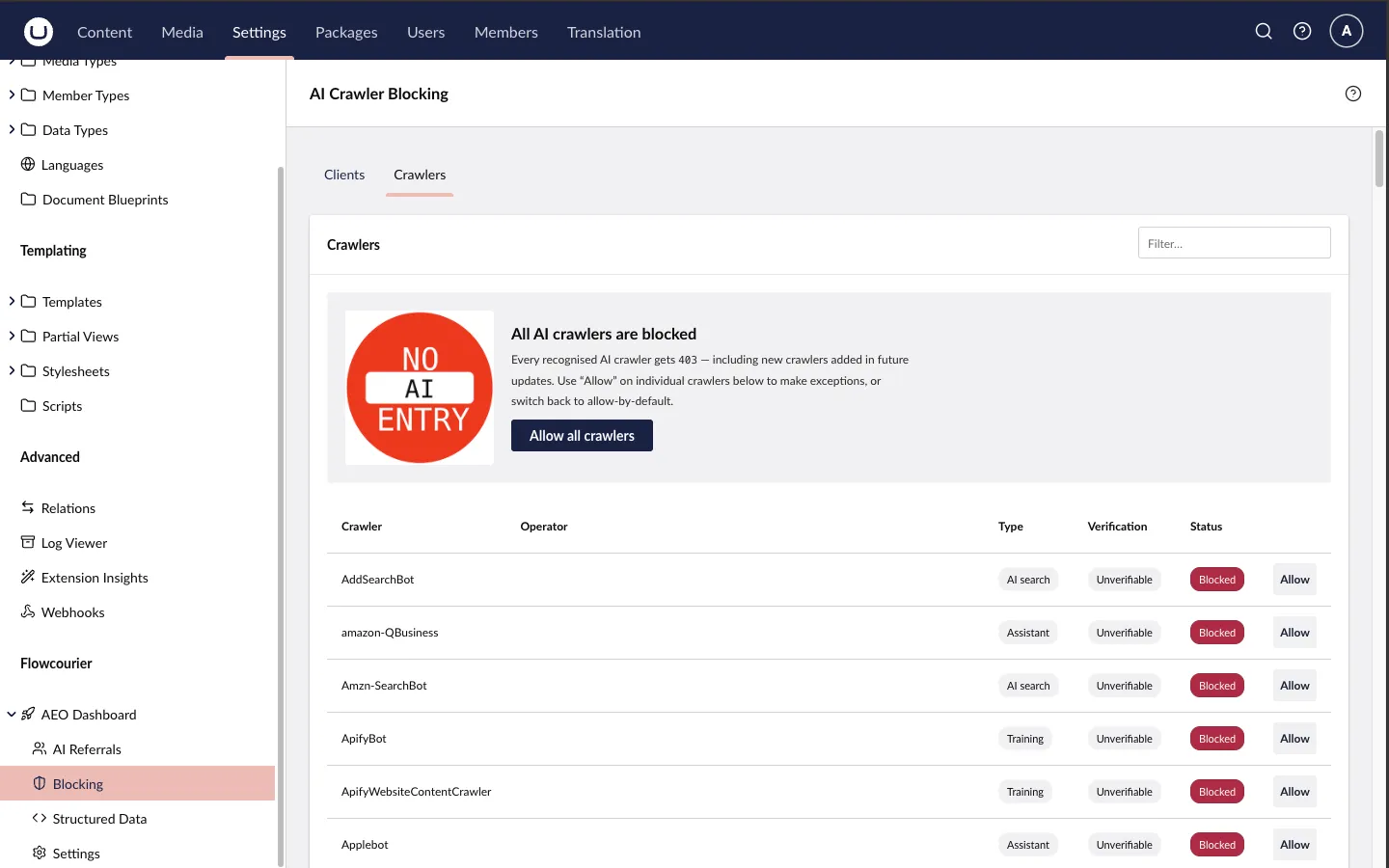
Crawlers tab
Section titled “Crawlers tab”- Every tracked crawler with its verifiability and a permanent Block/Unblock
toggle. Blocking a crawler here answers all its requests with
403— an enforced block, unlike advisoryrobots.txtrules that scrapers are free to ignore. Use it for crawlers you never want (say, Bytespider), verifiable or not. - Block all switches from the default allow-by-default to
deny-by-default: every recognised AI crawler gets
403— including ones added in future registry updates — except the ones you then Allow. It’s a deliberate, confirmed switch; the allowlist you build under it is remembered if you turn it back off and on. Combine it with the Markdown/llms.txt surface only if you truly want zero AI crawling; most sites want the opposite.
Privacy (GDPR)
Section titled “Privacy (GDPR)”The crawler-analytics tables still store no IP addresses, no raw user-agent strings and no query strings. Verification compares addresses in bounded, TTL-expiring memory caches only.
The one deliberate exception is the security block list: a durable block
has to remember the offending address to survive a restart, so
FcAeoBlockedClient stores offender IPs — security-scoped, visible only to
backoffice admins, and auto-pruned on the DurableBlockRetentionDays window.
Processing an attacker’s IP for abuse prevention is a textbook
legitimate-interest basis, the same one every WAF and fail2ban setup relies on.
If you want a strict no-IPs-ever posture, set
StrikesBeforeDurableBlock: 0 — in-memory spoof blocking keeps working and
nothing IP-shaped is ever written.
Behind a reverse proxy or CDN?
Section titled “Behind a reverse proxy or CDN?”Verification compares the connection’s address, so behind Cloudflare (or any
CDN) the app sees the edge’s IP instead of the crawler’s. AEO recognises known
edge networks (Cloudflare’s published ranges are built in) and fails open:
crawlers read as unverifiable and are never blocked or striked — until you
set CrawlerAnalytics:ClientIpHeader (Cloudflare: CF-Connecting-IP), which
restores full verification. The “AEO Client IP / Forwarded Headers” health
check (Settings → Health Checks) tells you which case you’re in and the
exact setting to add. The full walkthrough — edge bot settings included — is
in the dedicated Cloudflare & CDNs
guide.
Behind a plain reverse proxy or load balancer (nginx, HAProxy, IIS ARR),
configure ASP.NET Core’s
Forwarded Headers middleware
in the host site instead — AEO deliberately never parses X-Forwarded-For
itself.
appsettings reference
Section titled “appsettings reference”All settings live under Flowcourier:Aeo:BotVerification and are optional:
{ "Flowcourier": { "Aeo": { "BotVerification": { "Enabled": true, "BlockSpoofed": true, "StrikesBeforeDurableBlock": 3, "DurableBlockRetentionDays": 90, // Per-crawler overrides (replace the built-in sources wholesale) "Bots": { "claudebot": { "IpListUrls": [ "https://claude.com/crawling/bots.json" ], "Cidrs": [], "RdnsSuffixes": [] } } } } }}| Setting | Default | Description |
|---|---|---|
Enabled |
true |
Verify claimed AI crawlers and record a verdict per hit. |
BlockSpoofed |
true |
Answer provably spoofed requests with 403. Off: spoofed hits are recorded but served. |
ExemptPrivateNetworks |
true |
Never verify or block loopback, private or link-local addresses — keeps local development working. Disable to test enforcement locally. |
VerifiedBotHeader |
null |
Header injected by a trusted edge that already verified the crawler — recorded as verified (method header), IP-list/rDNS checks skipped. Only use a header your edge strips from client requests. |
TrustedEdgeCidrs |
Cloudflare’s published ranges | CIDRs of known CDN edge networks. Requests from these fail open as unverifiable while no ClientIpHeader is set (see Cloudflare & CDNs). Configured entries are added to the defaults. |
TrustedEdgeIpListUrls |
cloudflare.com/ips-v4, /ips-v6 |
Published edge-range lists refreshed at runtime on top of the static CIDRs. Configured entries are added to the defaults. |
StrikesBeforeDurableBlock |
3 |
Spoofed episodes from one address before it lands on the durable block list; 0 disables escalation (no IPs are ever written). |
DurableBlockRetentionDays |
90 |
Rolling window a durable block survives after the last offense; 0 keeps blocks forever. |
IpListRefreshHours |
24 |
Vendor IP-list cache lifetime (stale-while-revalidate; stale lists are kept on fetch failure). |
IpListFetchTimeoutSeconds |
10 |
Timeout per IP-list fetch. |
DnsTimeoutSeconds |
5 |
Timeout per reverse-DNS lookup; timeouts mean unverifiable, never blocked. |
VerifiedTtlHours |
24 |
Cache lifetime of a verified verdict per (crawler, address). |
SpoofedTtlHours |
1 |
Cache lifetime of a spoofed verdict — kept short so a vendor expanding its ranges self-heals quickly. |
UnverifiableTtlMinutes |
10 |
Retry cadence for pending or failed verifications. |
MaxCachedVerdicts |
50000 |
Soft cap on cached verdicts (memory backstop against scanner floods). |
MaxBlockedHitsPerMinute |
120 |
Cap on blocked hits written to analytics per minute — blocking itself is never rate-limited; 0 records all. |
Bots |
{} |
Per-crawler source overrides keyed by bot id: { IpListUrls, Cidrs, RdnsSuffixes }. Replaces the built-in descriptor wholesale; an empty descriptor makes that crawler unverifiable. |
Vendor sources being config-overridable means a moved URL or newly published range list is a one-line config change — no package update needed.
Testing it locally
Section titled “Testing it locally”Local requests come from a private address, which is exempt by default. To see enforcement work on a development site, disable the exemption and pin one crawler to a range that matches nothing real (TEST-NET-3):
{ "Flowcourier": { "Aeo": { "BotVerification": { "ExemptPrivateNetworks": false, "Bots": { "gptbot": { "Cidrs": [ "203.0.113.0/24" ] } } } } }}curl -i -A "Mozilla/5.0 (compatible; GPTBot/1.1)" http://localhost:5000/# HTTP/1.1 403 Forbidden — provably spoofed (your IP is not in 203.0.113.0/24)A normal browser user agent still gets 200, and the request shows up in the
dashboard with a red Spoofed · blocked badge. Remember to revert the
override — and note that three such tests will durably block your own loopback
address until you remove it on the Blocking page.